
At Regional Meeting…
ONS Director Presents Sierra Leone’s Upgraded Security Framework Architecture

By: turayahmedyusuf586@gmail.com
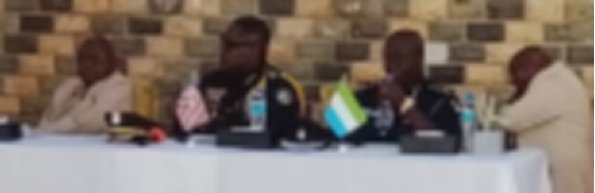
A high-level bilateral security meeting between the Sierra Leone Police (SLP), and the Liberia National Police (LNP), that; during the engagement brought together senior police leaders, national security experts, and representatives from key institutions to strengthen cooperation on cross-border crime, intelligence-sharing, and regional stability.
The meeting formally welcomed the Inspector General of the Liberia National Police and National Security Coordinator, Gregory O. W. Coleman, who led the Liberian delegation.
ONS Principal Director Highlights Key National Security Reforms delivering a detailed PowerPoint presentation, Alhaji Morlai Kargbo, Principal Director at the Office of National Security (ONS), provided a comprehensive overview of Sierra Leone’s evolving national security architecture.
He explained that Sierra Leone’s security landscape has undergone significant transformation in response to emerging threats, regional instability, cyber risks, and global security trends. The government, he said, has adopted a coordinated, intelligence-led, and community-focused security model that strengthens collaboration among all national security institutions.
Kargbo outlined progress in early-warning systems, inter-agency coordination, strengthened local security committees, and targeted reforms to modernize the country’s security sector.
According to him, government investments in training, logistics, technology, intelligence infrastructure, and community partnerships are enhancing the sector’s ability to prevent, detect, and manage security threats including cybercrime, organized crime, youth violence, disaster management, and border insecurity.
He reaffirmed the government’s commitment to national cohesion, citizen protection, and building an enabling environment for development and democratic governance. Kargbo encouraged communities and the media to support national security efforts through vigilance, accurate information-sharing, and constructive collaboration.
Breakdown of Sierra Leone’s National Security Architecture
1. Overview
Kargbo explained that Sierra Leone’s security architecture operates through both intelligence and operational layers.
At the national level, the Joint Coordination Centre (JCC), serves as the central police-led coordination hub bringing together the military, fire force, corrections service, and humanitarian partners. This structure is replicated at regional, district, and provincial levels, ensuring seamless information flow from national policy to community-level execution.
He also highlighted three specialized committees supporting targeted investigations:
1. National Confrontation Committee
2. National Organized Crime Unit
3. Joint Chiefs of Investigation
2. National Security Council (NSC), Roles & Functions
The National Security Council remains Sierra Leone’s highest decision-making body on security. Its responsibilities include:
Assessing internal and external threats
Directing operations of sub-committees
Approving major security strategies
Monitoring external military support
Coordinating national security and policing policies
Providing guidance during conflict or crises
Kargbo referred to the NSC as the institution that “drives the nation’s security posture through policy direction.”
3. Instruments of National Power
Security directives from the NSC are executed across six strategic power instruments:
1. Diplomatic Power Ministry of Foreign Affairs
2. Information Power Ministry of Information
3. Security Power Security and intelligence agencies
4. Economic Power Ministry of Finance
5. Civil Society Engagement Community and national stakeholders
6. Legal Power; Judiciary and legislative bodies
This ensures a whole-of-government approach to national security.
4. NSC Core Membership
Core members include:
President (Chair)
Vice President (Vice Chair)
Chief Minister
Ministers of Finance, Defence, Internal Affairs, Information, Justice, and Foreign Affairs
Secretary to the President
Head of Security Administration
Head of the Office of National Security
Inspector General of Police
Chief of Defence Staff
Director General of National Intelligence
Head of Strategic Institutions (ONS), serving as Secretary to the NSC
SLP Inspector General Calls for Deeper Cross-Border Collaboration
In his opening remarks, Inspector General of Police William Fayia Sellu stressed that Sierra Leone and Liberia share strong geographic, cultural, and socio-economic ties that require coordinated, proactive, and intelligence-driven policing.
“Our security challenges are interconnected. Whether it is trafficking, organized crime, or community disturbances, these threats do not respect borders,” IGP Sellu stated.
He reaffirmed the SLP’s commitment to building a safer Mano River Union (MRU), region through strengthened cooperation.
Liberia Police Chief Emphasizes Stronger Joint Security Mechanisms
Liberia’s IGP and National Security Coordinator, Gregory O. W. Coleman, expressed his country’s readiness to deepen bilateral cooperation.
He underscored the importance of mutual trust, improved communication channels, coordinated border patrols, and enhanced intelligence-sharing between the two nations.
Coleman described the engagement as “an important step toward deepening regional security partnerships and ensuring safer communities across both countries.”
The Minister of Internal Affairs served as the guest of honour at the meeting.
Technical Presentations and Expert Discussions
Several expert presentations were delivered by representatives of key security institutions, including:
ONS National Security Architecture Presented by Alhaji Morlai Kargbo
Transnational Organized Crime: Strategies & Challenges Presented by Mohamed Kargbo Alieu of TOCU
SLP Strategic Development Plan (2025–2029), Presented by AIG Esther Mary Kaintor Duckuray, Director of Corporate Affairs
A lively question-and-answer session followed, addressing policy gaps, operational constraints, and opportunities for enhanced bilateral action.
In conclusion: The bilateral engagement concluded with both security chiefs agreeing to develop a comprehensive security cooperation framework outlining priority areas, implementation timelines, and monitoring strategies.
Stakeholders hailed the meeting as a major milestone that strengthens mutual trust, improves operational synergy, and reinforces the long-standing security partnership between Sierra Leone and Liberia.